
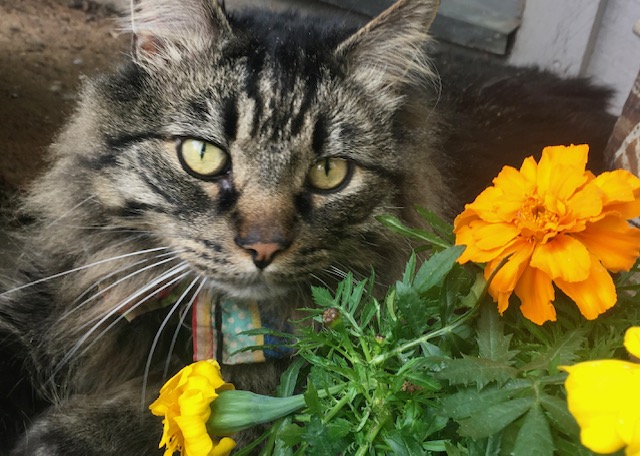
Milo, our cat, in his younger days.
My cat is old.
He seems to be having trouble walking. I can hear him coming when he is in the other room; there is a click, click, click that wasn’t there before.
We got our cat, Milo, when my daughter was in fifth grade. We had just moved back to California and were temporarily living with my parents (a temporary situation that ended up lasting two years). My daughter was stubborn and persistent and badgered us until we gave in and drove to the animal shelter thirty miles away. The shelter staff took us to a private room and brought cats in, one at a time, to meet us.
Milo was not the first cat we met. He was the second. He was slender and grey and went right up to my daughter, leaned in, and purred. The shelter staff guessed that Milo was about four years old. Years later, our vet said that she doubted that, that he was probably only two or so when he arrived at the shelter. In any case, he is clearly an elderly cat now. He was not a kitten when we adopted him toward the end of 2011; by any calculation, he is at least sixteen years old and possibly could be almost eighteen.
He was adorable. He was our cat. Actually, he was my daughter’s cat; we had her sign his adoption papers and listed her as his owner. She promised, as children do, that she would care for him. She would definitely clean his litter box.
I’m sure that she did at first, but it was a new experience for all of us, having an indoor cat. When I was growing up, we had five cats, but they all lived outside. They ate out of a common bowl. They were with us, until one day they weren’t. We never knew what happened to them. It was sad when they disappeared, but sometimes it took awhile before we realized they were gone.
I don’t know how much longer Milo will be with me. I do know that caring for him is becoming a job that takes more and more of my time. He is having issues that apparently plague the elderly of many species. He has problems with his eyes (cataracts, the vet said) and with his kidneys, which is why he drinks more water than he used to. He has always been a big cat and has never had the easiest time grooming himself, just because there is so much of him—but it seems that he’s having a harder time than before. Kitty litter gets stuck to his paws and ends up in clumps on the floor all over the house.
It is not my favorite thing, sweeping up kitty litter from the bathroom floor, the kitchen floor, the living room floor, my bedroom floor. It seems like it is everywhere.
I’m trying to care for my old cat with love. I am having to accept that it is my job now: to mop his wet kitty-litter paw prints off the floor, sometimes twice a day. If I am smart, I clean his litter box in the morning and evening too, because a little attention at the end of the day makes the morning easier. I’m trying to approach these tasks with patience. I’m trying to make my old cat’s days a little sweeter, to let him know that he is always loved.
But I’m afraid it’s time to call our vet to schedule a “quality of life” visit. Apparently, that’s something you can do to talk about a pet’s condition, to get a professional opinion on how a beloved pet is truly faring. Milo’s still eating (as much as ever, and nudges me when his bowl is empty) and can still jump up to his favorite spot on the couch, but he’s having a little difficulty walking and definitely isn’t grooming himself like he used to—hence the kitty-litter patties appearing all over the house.
The experts say that it’s “better to be a little early than clearly too late” when thinking about putting a cat down, because “too late” means that cat has already been in severe pain, distress, or panic (thanks to Perplexity.ai for that information). They say that “euthanasia, when a pet is near the end of life and suffering, is considered a ‘good death’—a way to allow a peaceful passing rather than a prolonged decline.”
Tonight, Milo is stretched out on his pillow a few feet away from where I’m writing at the kitchen table. I can hear him snuffling. He seems fine, doesn’t he? He’s old, sure, but he’s still okay, mostly?
I hope so, but I’m not so sure anymore. Maybe there is something I can do to help him, to make him more comfortable if he is in pain. He doesn’t seem like he is in pain—but all my friends who know more about cats say that cats hide their pain and work through it like Olympic cross-country skiers. That’s why it will be good to schedule that vet visit—to bring in someone with an outside, expert opinion. And to listen to what she has to say, even if it might break all of our hearts.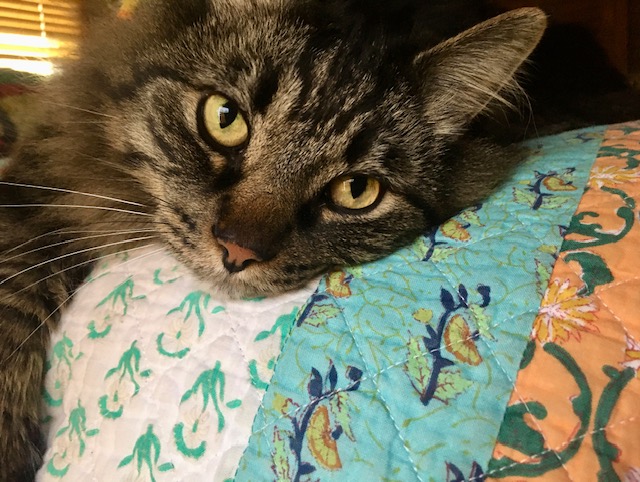




1 Comment
It’s always difficult when pets get as elderly as Milo has become.
We once had an elderly cat which I wonder if we should have euthanized. She was struggling – in retrospect was it worse than I thought? I’m not sure she was in pain, but I’m not sure she wasn’t either. She certainly had neurological problems, incontinence, and a definite hitch in her get-along. The vet also said her kidneys were in bad shape.
She got outside and disappeared. She could not have gotten too far, but we don’t know what happened to her, and therein lies the rub.