
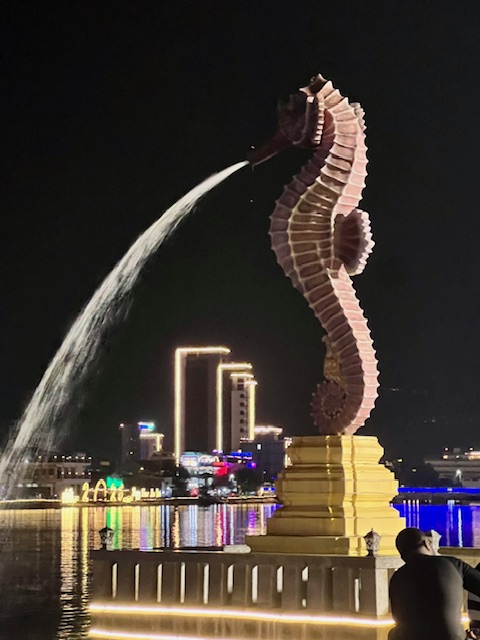
Seahorse Statue fountain in Kampot, Cambodia. Photo by my daughter, who did not buy the middle-aged man a chicken.
My daughter did not buy the middle-aged man a chicken.
She has been traveling throughout Asia since last November and had just arrived in Kampot, a good-sized city in Cambodia known for Kampot pepper. Kampot pepper is said to be the finest pepper in the world. It’s the first Cambodian product to receive “Protected Geographical Indication Status” from the European Union, which means it has the same legal protection and status as Champagne and Roquefort cheese. The town is nestled along a river and is a favorite of expats. She’d had a long day of travel that included two hours of waiting for a train that ended up being an hour late.
She checked into her hostel and headed to a small convenience store just to buy shampoo.
She was at the counter, paying for her items, when a white man burst in (probably American, judging from his accent) and made a beeline for her. He ignored everyone else in the store, told her he hadn’t eaten all day, said he was hungry, and asked if she could buy him a chicken.
She said no. Just no.
After she spoke, he said, “Are you American? Where are you from?”
She said, “I do not want to talk right now,” or something close to that. But he didn’t go away. He kept pushing, pushing.
Finally, she said, “Yo, dude! I’m a broke backpacker too. Why are you even asking me this?”
Finally, he left.
Thankfully, he left.
I was so proud of her.
I can imagine how I would’ve handled that situation. I’m certain I wouldn’t have said no in such a confident manner. Sure, I manage to say “no, thank you” to the people sitting in front of Walmart who want me to sign petitions (generally ones that go against most everything I believe in), or the salespeople at Costco who want me to upgrade my phone. I don’t think I would have “bought him a chicken,” but I probably would’ve felt a little guilty. I had years of Sunday school growing up in my Baptist church, and Jesus’ words about being generous—and giving away your cloak if someone asks for it—run deep in my conscience. This poor man was hungry! Aren’t we supposed to feed the hungry?
Yes, we are supposed to feed the hungry—but that was not my daughter’s job that evening. She stated her boundary, held firm to it, stood her ground. She didn’t default to my usual response when faced with a request from a stranger—to be pleasant, to be kind, to be nice, even when I’m saying no. It’s tricky when we are out in the world and meet people who say they need help. But is it appropriate for a middle-aged man to approach a young woman in public and make such a demand?
I don’t think so.
Maybe there’s a way to reframe Jesus’ command to love our neighbors as ourselves. In a situation like that, my daughter’s loving herself—taking care of herself—was simply saying no.
Probably not the best way to start her visit to a new town.
But she went on that evening to visit the river and saw the Seahorse Statue that, in her own words, “people seem to be making a big deal of.” Then she found an Indian restaurant, had butter chicken with fresh naan bread, and eventually discovered an ice-cream shop where “a bunch of older white people were sitting out front” (possibly a few of the expats mentioned earlier). She tried a scoop of Kampot pepper ice cream, because you have to try something like that when you are in the town that made it famous, and a scoop of Oreo for good measure.
No, she would not buy him a chicken, but she didn’t let the interaction ruin her evening. She didn’t need to be nice; she didn’t need to be kind. He was a grown man traveling abroad and he’d made it that far, just fine. He could figure it out himself.




1 Comment
So proud of her! Boundaries are so important, especially for young women traveling alone.